
Op-Ed | NC A&T students: Why do we have to keep fighting?
This op-ed was originally published on April 17, 2026, in Greensboro News & Record
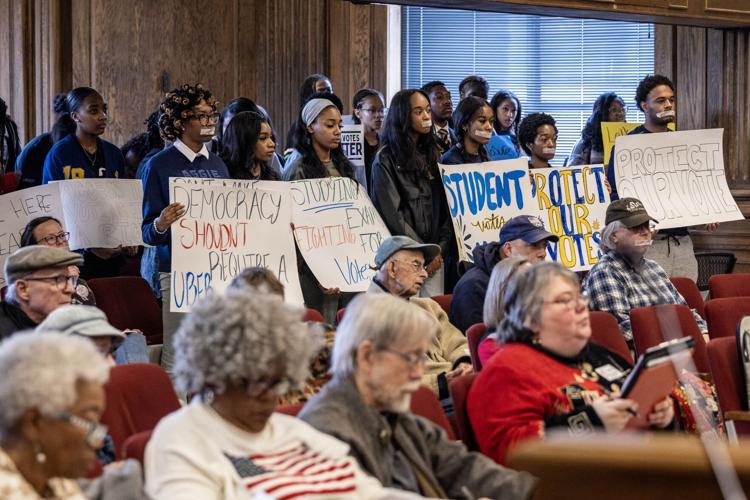 North Carolina A&T students hold protest signs at the Guilford County Board of Elections meeting in Greensboro on Nov. 18. The students were seeking an early voting site on the university’s campus during this year’s primary. The students appealed to the State Board of Elections, which also denied their request.
WOODY MARSHALL, News & Record
On Jan. 13, students from North Carolina A&T traveled to Raleigh to attend a State Board of Elections meeting. Many of us missed class, while others had taken time off from work.
We packed into the room with one simple request: Restore an on-campus early voting site for our campus. For many of us, this was not our first time sitting in a room where decisions about our voting access were being made in real time. When the vote finally came, the board rejected the proposal.
The moment was truly disappointing. We had traveled there, hopeful that our concerns would be heard, only to leave feeling as if our voices and our votes were being dismissed.
But we are not done. Since then, A&T students have continued advocating for an on-campus polling site and mobilizing students to reach the off-campus polling site.
This isn’t the first time we’ve had to fight this battle. So, the question remains: Why do we keep having to?
We didn’t fill that conference room in Raleigh to cause disruption. We did it because this fight is embedded in our blood. Our grandparents fought this same fight. Our parents told us stories about the protests they participated in. Students who graduated years ago still carry the memories of marching to make their voices count. But there is something exhausting about walking into a room and being told, again and again, that our access to voting is up for debate.
Ours wasn’t the only North Carolina campus that was denied a polling place.
Elon University and Western Carolina University also were not granted early voting sites for the primary, even though both institutions had hosted them in the past.
On-campus early voting is not just a matter of convenience; it’s essential access for college students. Many students are juggling jobs, classes and extracurriculars. For those of us who live on campus, getting off campus to vote isn’t always feasible, as the nearest polling site is a 30-minute walk away. An on-campus polling site would ensure fair and equitable access to voting.
Research from Tufts University’s Center for Information & Research on Civic Learning and Engagement found that nearly half of Americans between the ages of 18 and 29 voted in the 2024 presidential election. These numbers challenge the outdated stereotype that young people are disengaged or apathetic about politics. In reality, young voters are paying attention and participating. The question is whether the systems around us are built to support that participation.
N.C. A&T is also the largest historically Black college or university (HBCU) in the country. Taking away our on-campus polling site disproportionately affects Greensboro’s Black voters and our ability to ensure that our voices as HBCU students are heard.
Across the country, debates about youth voting access have increasingly centered on college campuses, with some policymakers questioning or challenging the presence of campus polling locations. While these conversations are often framed as administrative decisions, the impact is clear: When voting locations move further away from students, participation becomes more difficult.
For the primary elections, A&T did have a precinct on campus on Election Day, but Election Day fell in the middle of our spring break, when no students were on campus for classes or housing. This raises a question that deserves a direct answer: Who is this precinct serving? Are the resources being spent on this precinct being adequately used? Could those same resources have been redirected to an early voting site that actually serves the people who live and study here?
College is where many of us build lifelong habits, and voting is one of the most important habits we build as citizens. We should be able to vote in the same place where we live, learn, love, and grow. We are working today to ensure that future Jyannes and Zayveons do not have to protest or march to the polls.
We know there is a certain kind of grief that comes with seeing the rights that your ancestors fought for being taken away right in front of your eyes.

About the Authors
Zayveon Davis is a second-year business administration student and Toyota Scholar at N.C. A&T. Jyanne Guide is a third-year Honors Public Relations Student at N.C. A&T. Both are student ambassadors for The Andrew Goodman Foundation, a nonpartisan nonprofit that engages young voters and challenges voter-suppression laws. The organization is named after Andrew Goodman, a Freedom Summer volunteer who was murdered, alongside James Earl Chaney and Michael Schwerner, by the KKK in 1964 while registering Black Americans to vote in Mississippi.
