Campus Connections: Q&A With The University Of San Francisco

This year, AGF is celebrating ten years of impact with the Andrew Goodman Vote Everywhere Program. As we reflect on how the program has grown, the Campus Team at the University of San Francisco reflected on the past seven years and their hopes for the future of civic engagement on the campus in San Francisco, California.
The University of San Francisco has been an Andrew Goodman Vote Everywhere campus since 2017! What barriers to voting existed on campus prior to 2017?
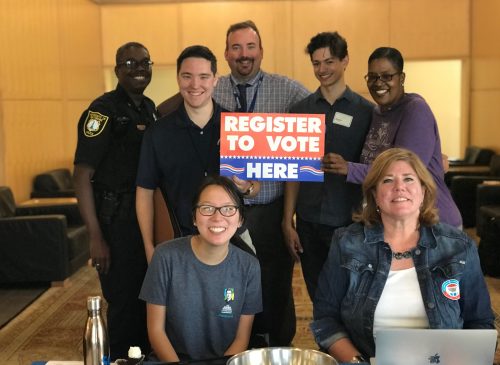
Before the support from Andrew Goodman Foundation in 2017, the USF Campus did not have any centralized center, infrastructure, or processes that connected students to voter engagement, registration, or education. Now, we have a solid team, a strong communications strategy, visibility, resource funding, and partnerships with the local election department to have two polling places on campus come election day.
From what you know of how things were in 2017, when it comes to voting and civic engagement on campus, what are some of the most noticeable changes?
There is more visibility about civic engagement. Our Andrew Goodman Foundation USFVotes team has been very intentional about demystifying voter access to the ballot box, and are taking full advantage of this new age of social media and an online presence. Additionally, engagement on campus starts before students enter the university through a community engaged learning module, we work closely with ITS and the Registar to embed voter registration links at various points in the school year.
How has the general campus’ perception of voting and civic engagement evolved since 2017?
The NSLVE reports have demonstrated that the USF campus engagement has increased cumulatively, particularly in general election years. Students are aware and more engaged in the issues, there are more opportunities to partner and have stakeholder buy-in, and institutionalize voting as a part of the campus culture. More faculty and staff also have interest in building civic engagement more readily into their modules particularly around the Civic Holidays timeframe.
How has your Campus Team reflected on the legacy of Andrew Goodman, James Earl Chaney, Michael Schwerner, and Freedom Summer 1964 over the years?
We recognize the legacy of Andy, James, and Michael and include it in our trainings, any media opportunities, and in speaking with leadership and other stakeholders. Their story is a powerful one, particularly to young people when we are thinking about collective liberation within a multi-ethnic, multi-religious, multi-cultural coalition building like what these three young men sought to do in Summer 1964. We use every opportunity annually to recognize the history of those who came before us at various programming events on campus and when we meet students.
What are some ways that the Andrew Goodman Vote Everywhere program has supported your efforts on campus to increase voter and civic engagement?
The support from the Andrew Goodman team is phenomenal and really helped our campus be part of a national coalition. It would not have been the case if not for the funding from the foundation to compensate our student leaders, be thought partners on challenges that universities and colleges face, and to be part of a community with shared resources.
What are your hopes and dreams for what civic engagement will look like on campus four years from now?
That our voter turnout rate exceeds the national average, or is 95% which is 20% higher than our last presidential election turnout numbers in 2020. We hope that civic engagement modules are in every department, from Engineering to Business Management and others so that students in those sectors also see the intersectionality of what they learn and how it is connected to participation and engagement.
What are the team’s main goals to increase and support voter engagement and turnout in 2024?
One-on-one interaction with everyone we meet so that they feel comfortable and confident when they vote. We also want to institutionalize voting more seamlessly so having conversations with University leaders is tantamount so that the Cabinet and Deans are aware and also part of the stakeholder process and buy-in. We also want to recruit and train new students who can take on the reins in 2024 and beyond so that it is a sustainable model.
Is there anything else you would like to share?
Thank you to The Andrew Goodman Foundation for all of your support and partnership!
Stay tuned as we continue our Campus Connections series, featuring each of our Andrew Goodman Vote Everywhere Campus Teams, the impact made on campus, and how they are living the legacy during this pivotal point in our nation’s history.